

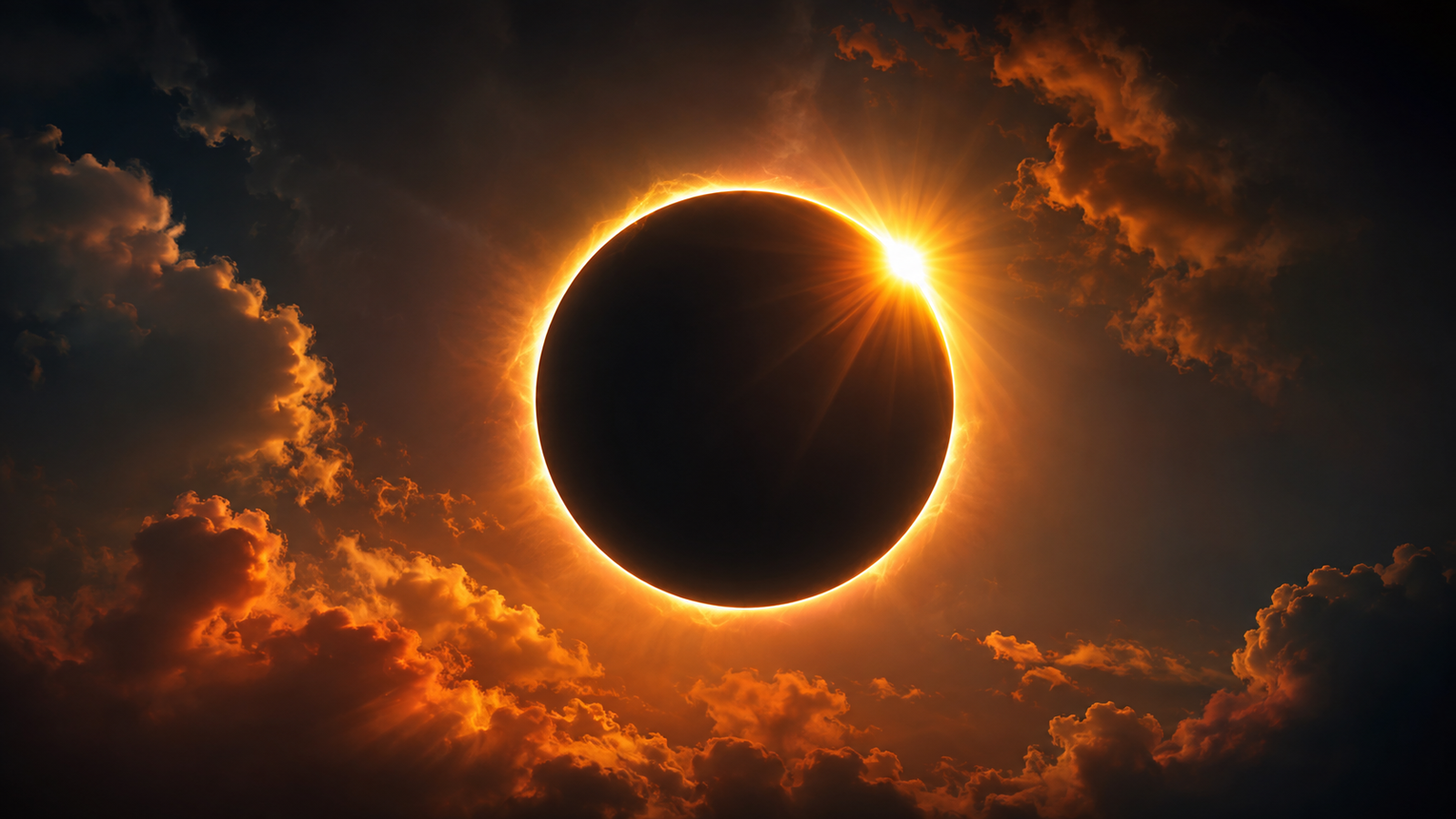
The Solar Eclipse 2026 is one of the most anticipated astronomical events of the year. On August 12, 2026, the Moon will pass directly between Earth and the Sun, creating a total solar eclipse in a narrow path across parts of the Northern Hemisphere. According to NASA, totality will be visible across Greenland, Iceland, northern Russia, Spain, and a small part of Portugal, while a partial eclipse will be visible across much larger areas of Europe, Africa, North America, and surrounding oceans.
What Is a Total Solar Eclipse?
A solar eclipse occurs when the Moon moves between the Earth and the Sun and blocks some or all of the Sun’s light. During a total solar eclipse, the Moon completely covers the bright surface of the Sun for observers located within the path of totality. This brief period allows the Sun’s outer atmosphere, known as the corona, to become visible.
The 2026 eclipse is particularly exciting because totality will occur in several locations with potentially spectacular viewing conditions, including Iceland and Spain. In many places, the eclipse will happen relatively late in the day, producing dramatic changes in daylight and potentially creating an unusual eclipse-at-sunset experience.
Where Can You See the 2026 Solar Eclipse?
The path of totality crosses northern Russia, Greenland, Iceland, the North Atlantic, Spain, and a small corner of Portugal. Outside this narrow path, observers in many countries will experience a partial eclipse.
For example, NASA lists Reykjavík, Iceland, as experiencing totality from approximately 5:48 p.m. to 5:49 p.m. local time. In Madrid, Spain, the eclipse will reach approximately 99% coverage, while cities such as London, Paris, and Lisbon will also experience substantial partial coverage.
Why Is This Eclipse Important?
Solar eclipses provide scientists with valuable opportunities to study the Sun and Earth’s atmosphere. NASA-supported teams will use aircraft, cameras, and scientific balloons during the August 12 eclipse to investigate the solar corona and atmospheric changes caused by the sudden reduction in sunlight.
For ordinary observers, however, the eclipse is also a remarkable natural spectacle. The daylight can become noticeably darker, temperatures may change, and the appearance of the sky can become dramatically different within minutes.
How to Watch the Eclipse Safely
Eye safety is extremely important. During the partial phases, never look directly at the Sun without proper solar viewing protection. Regular sunglasses are not sufficient. NASA recommends eclipse glasses or handheld solar viewers that meet the ISO 12312-2 standard.
People can also use an indirect viewing method, such as a pinhole projector. During the brief period of totality, observers within the path of totality may look directly at the completely eclipsed Sun, but eye protection must be used again as soon as the bright solar surface begins to reappear.
Final Thoughts
The August 12, 2026 total solar eclipse will be a spectacular astronomical event, especially for people fortunate enough to be inside the path of totality. With totality lasting only a few minutes or less at many locations, careful planning and safe viewing equipment are essential. Whether watched from Iceland, Spain, Greenland, Russia, or another location experiencing a partial eclipse, Solar Eclipse 2026 offers a memorable opportunity to witness the Moon, Earth, and Sun align in one of nature’s most extraordinary displays.